teaching
Animal Classification Activities for Kids
Five practical animal classification activities that use real species cards for classroom and home learning.
· 4 min read
Generate animal prompts
Choose a starting point to generate animal prompts with the layout each activity calls for.
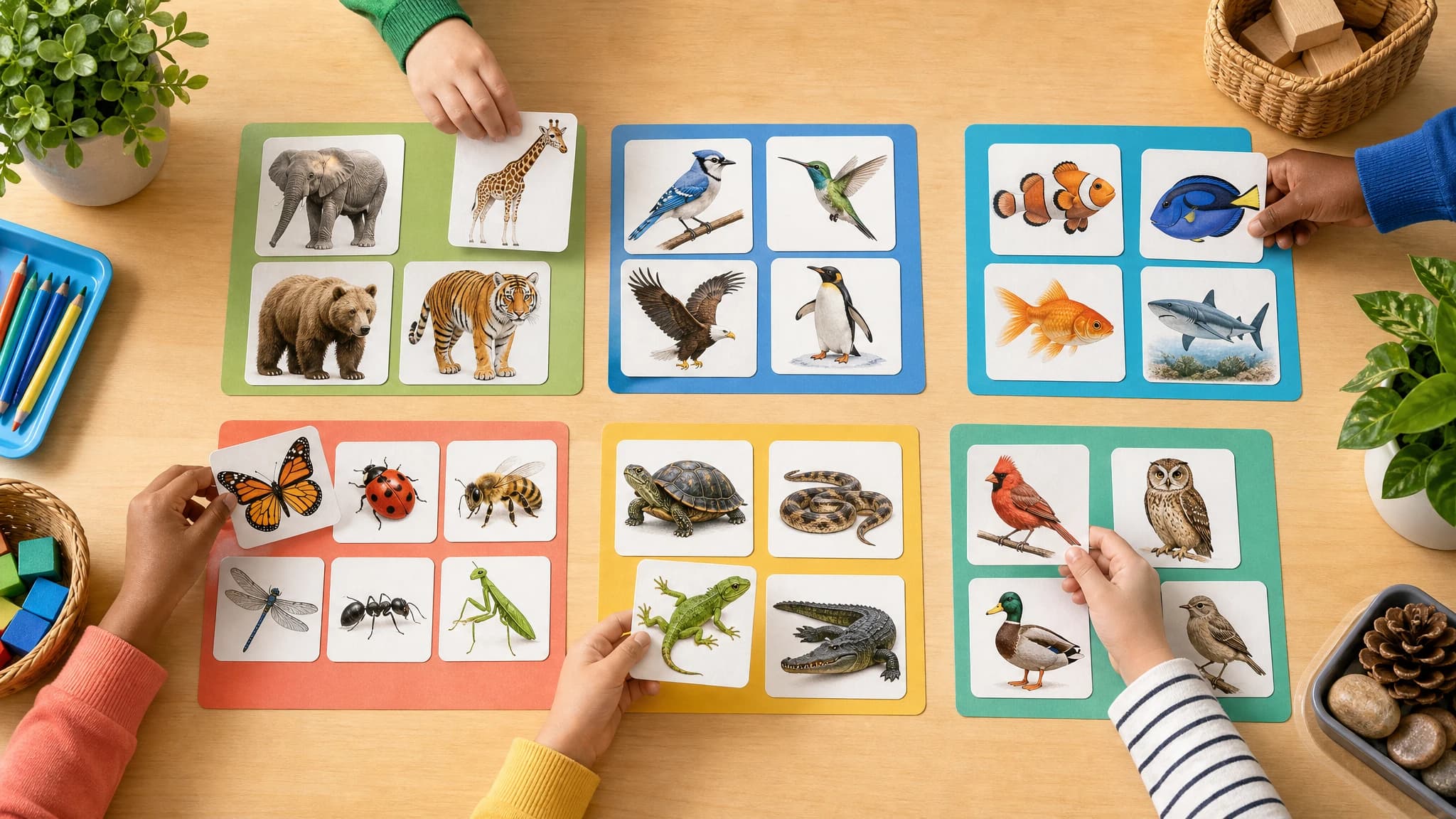
Animal classification becomes easier when children can move, compare, and defend their choices. Real species cards give the activity a useful amount of challenge: a child can start with a visible feature, then use evidence to explain why an animal belongs in a group.
Begin with a small set of cards and add complexity only when the group is ready. A random animal generator for animal classification gives you fresh, real species cards without having to build a list by hand. The mammal classification card set is a simple starting point because children can compare familiar traits before they need to weigh less obvious clues.
Five-pile card sort
- Setup
- Make five clear spaces on a table or floor for mammals, birds, fish, reptiles, and insects. Generate or print a mixed stack of animal cards, including a few species that children may not know immediately.
- Child action
- Children take turns choosing a card, placing it in a pile, and naming one visible clue that guided the decision. Invite the group to pause whenever a card creates disagreement rather than correcting it straight away.
- Discussion question
- Which clues help most when an animal looks unfamiliar: body covering, number of legs, how it moves, or where it lives?
Mystery animal clues
- Setup
- Keep the picture side of each card hidden, or read only a few details aloud. Choose clues from the scientific name, habitat, diet, native region, and conservation status.
- Child action
- Children listen, record a prediction, then decide which broad group is most likely. Reveal the image after they explain the evidence they used.
- Discussion question
- Which clue changed your mind most, and why was it more useful than a first guess based on the animal's name?
Move to the right corner
- Setup
- Label five corners or wall areas with the classification groups. Give every child an animal card, then make enough room for safe movement.
- Child action
- Children move to the corner that matches their animal. Once there, pairs compare their cards and prepare one sentence explaining why both animals belong in the same group.
- Discussion question
- Did animals in the same group live in the same habitat, or can one classification group include species from very different places?
Classification detective notebook
- Setup
- Give each child a notebook page with spaces for an animal's scientific name, habitat, diet, native region, classification group, and one question for further research.
- Child action
- Children choose a card and collect evidence before writing a short case report. They can use a scientific name to search precisely, compare habitats and diets to explain adaptations, map native regions, and note whether conservation status suggests a research question about threats or protection.
- Discussion question
- How does recording evidence make your classification claim stronger than simply saying an animal looks like it belongs in a group?
Build a new animal and defend the category
- Setup
- Provide drawing paper, simple collage supplies, or a shared whiteboard. Ask children to invent an animal by choosing a body covering, movement style, habitat, diet, and native region.
- Child action
- Each child presents the new animal, assigns it to one of the five groups, and defends the classification with at least two traits. Classmates can ask respectful follow-up questions when a trait seems to point to another group.
- Discussion question
- What would you need to change for your invented animal to belong in a different classification group?
Make the activity fit your group
For younger children, use a smaller set with obvious visual clues and let them sort collaboratively. For older learners, mix categories, hide the pictures, or ask them to compare evidence that does not always line up neatly. Scientific names, habitat, diet, native region, and conservation status turn a simple card into a compact research prompt: they encourage children to ask how an animal lives, where it belongs, and what evidence supports a claim.
Choose one activity for a short warm-up, or combine two into a longer lesson. When you need a new mixed set for the next round, use the animal classification card generator to create cards with images and species details. More activity ideas will appear on the RandomLab Blog as they are prepared for publication.